Product pages leave doubt unanswered
Browsers become buyers when a page addresses hesitation — and most product pages do not.
Website & E-commerce
Tighten the store experience from product discovery to checkout so more shoppers feel confident finishing the order.

What clients feel first
Browsers become buyers when a page addresses hesitation — and most product pages do not.
Navigation, cart details, and checkout steps that feel unclear create drop-off before the sale.
A store that gets visits but not enough purchases has a conversion problem, not a traffic problem.
Who we are
We improve product pages, navigation, and checkout flows so more of the traffic already arriving turns into completed purchases.




The work path
We begin with one free consulting session to understand your products, target customers, store challenges, traffic sources, conversion goals, and priority pages. We then prepare a proposal outlining the recommended scope, timeline, and optimization priorities.
After payment or deposit is received, the project officially begins. We collect Shopify access, analytics data, theme information, brand assets, product details, app information, and examples of preferred experiences. You receive a confirmed project brief and implementation plan.
We review the homepage, collections, product pages, cart, navigation, mobile experience, apps, loading speed, content structure, and conversion journey. You receive a prioritized action plan showing the highest-impact opportunities.
We improve page hierarchy, navigation, collection organization, product discovery, promotional sections, trust elements, calls to action, and theme components using Shopify settings, Liquid, CSS, or approved apps where appropriate.
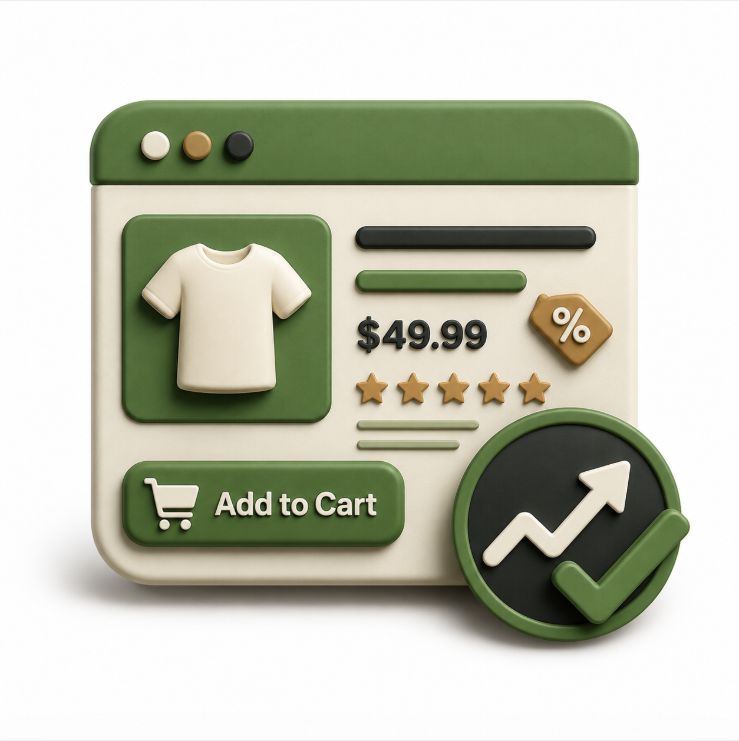
We strengthen product titles, descriptions, imagery, variants, pricing presentation, shipping information, reviews, FAQs, upsells, cross-sells, and add-to-cart flow. You receive clearer product pages designed to reduce hesitation and support purchase decisions.
We configure or review agreed tracking, such as GA4, Google Ads, Meta Pixel, and key e-commerce events. We also test mobile responsiveness, links, buttons, cart behaviour, forms, app conflicts, and page speed.
After approval, we publish the updates, verify that key shopping actions work correctly, and summarize the completed improvements. You receive the optimized Shopify store, tracking confirmation, and practical next-step recommendations.
Cost of delay
Confusing product pages, weak navigation, or checkout friction can stop customers before purchase.
Without strong product structure, photos, copy, trust signals, and upsell flow, shoppers may not see enough reason to buy.
If the store does not convert well, paid traffic becomes more expensive and less efficient.
Success stories
We were getting traffic, but the store experience still felt clunky in places. Evergrowth Digital's work made the site smoother and removed some of the friction that was costing us sales.

Kaitlyn
E-commerce Store Owner
A lot of what they changed was behind the scenes or easy to miss, but the store felt easier to shop afterward. That's what mattered most to us.

Richard
DTC Brand Founder
Product pages, structure, and overall flow all improved. The store looked more organized, and customers seemed to move through it with less hesitation.

Sophie
Online Retail Manager
We appreciated that they looked at both the user experience and the business side. Sophia helped clarify some messaging, and the store ended up feeling stronger overall.

Ian
Beverage Brand Owner
The site didn't need a dramatic redesign — it needed smarter refinements. That's what we got, and the improvements made the store feel more credible and conversion-focused.

Farah
Lifestyle Brand Founder
Shopify
WordPress

Framer

Webflow
Shopify
WordPress
Framer
Webflow
Shopify
WordPress
Shopify
WordPress
Framer
Webflow
Shopify
WordPress
Framer
Webflow
Shopify
WordPress
Next step
Improve product pages, navigation, checkout flow, and trust signals so more shoppers move toward purchase.
FAQ
Shopify optimization is the process of improving your Shopify store's design, structure, user experience, speed, product presentation, and conversion flow. It can include changes to the homepage, collection pages, product pages, cart, navigation, checkout experience, mobile layout, and added features. The goal is to make your store easier to browse, more trustworthy, and more likely to turn visitors into customers.
Evergrowth Digital can help optimize different Shopify pages, including the homepage, product pages, collection pages, landing pages, cart page, blog pages, contact page, FAQ page, about page, and policy pages. Each page has a different job. For example, the homepage builds first impressions, collection pages help shoppers compare products, and product pages help customers decide whether to buy.
Yes. Product pages are one of the most important areas for Shopify optimization. We can review or improve product images, product descriptions, benefit sections, variant display, price presentation, trust badges, reviews, FAQs, shipping information, related products, call-to-action placement, and mobile usability. A stronger product page helps shoppers understand the product faster and feel more confident before buying.
Yes. Collection pages help customers browse, filter, and compare products. We can improve collection layouts, product card design, filters, sorting, category structure, banner sections, internal links, and SEO content. If customers cannot quickly find what they need, they may leave before reaching the product page.
Yes. We can customize your Shopify store's visual style to better match your brand, including colours, fonts, spacing, buttons, banners, product cards, section layouts, image style, and overall design consistency. The goal is not just to make the store look nicer, but to create a shopping experience that feels clear, trustworthy, and aligned with your brand.
Yes, depending on your Shopify theme, apps, and technical setup. Added features may include custom sections, announcement bars, product badges, FAQ blocks, trust sections, lead forms, review displays, upsell sections, related products, bundle displays, size guides, contact forms, email signup areas, or custom landing page sections. We focus on features that support the shopping journey instead of adding unnecessary clutter.
Yes. Shopify themes can usually be customized through theme settings, templates, sections, and blocks. Depending on your needs, we may customize existing theme sections, create new layouts, adjust templates, improve menus, or recommend app-based features. If your current theme is too limited, slow, or difficult to manage, we may suggest a better theme or a cleaner setup.
Yes, Shopify optimization can support better conversion rates by reducing friction in the buying journey. This may involve improving page speed, product clarity, navigation, mobile layout, trust signals, call-to-action placement, checkout flow, and product page structure. It is similar to organizing a physical store: if customers can find products, understand value, and trust the business, they are more likely to buy.
Shopify optimization improves your existing store, while a full redesign changes the overall structure and visual system more deeply. Optimization is a good fit if your store already works but needs better performance, layout, product pages, or added features. A redesign may be better if the current store feels outdated, confusing, off-brand, or difficult to scale.
Shopify optimization cost depends on the number of pages, design complexity, theme limitations, custom code needs, app setup, added features, and testing requirements. A small product page improvement project is usually simpler than a full homepage, collection page, product page, and cart optimization package. To estimate clearly, we usually need your Shopify store link, current pain points, target pages, and desired features.