Your website received another enquiry overnight.
For a moment, it feels promising.
Then you open the message:
How much?
There is no location, service type, timeline, or useful context. Your team replies, waits several days, and never hears back.
The problem is not always a lack of leads.
Sometimes the business is attracting the wrong people—or making it too difficult for the right ones to explain what they need.
Traffic Is Not the Same as Demand
A roofing company in Langley may receive hundreds of website visits but only a few serious quote requests. A tutoring service in Mission may attract parents who browse several pages but leave without booking a consultation.
More traffic will not automatically fix that.
A lead-generation system must connect several parts:
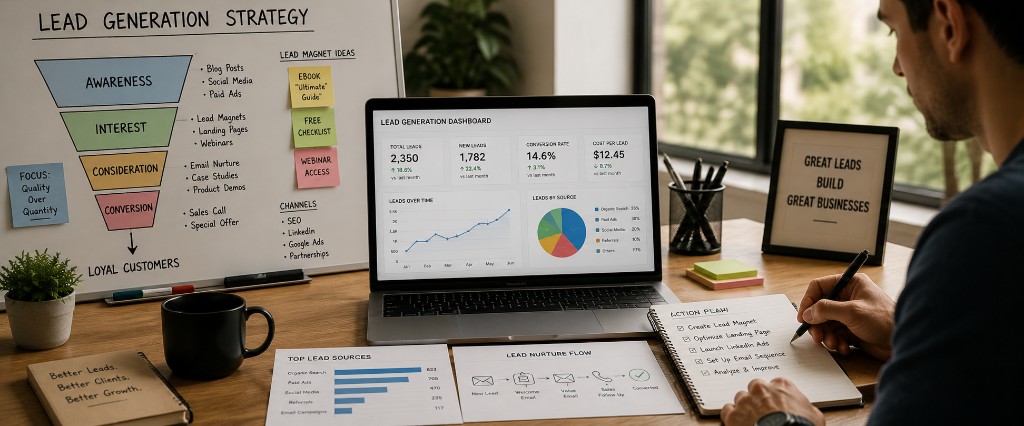
Audience → Offer → Message → Page → Form → Follow-up
When one part is unclear, potential customers quietly disappear.
Define Who You Want to Attract
Before launching a campaign, describe the lead your business can realistically help.
A qualified lead may depend on:
- Service required
- Location or service area
- Budget range
- Project timeline
- Business or customer type
- Level of urgency
For example, a renovation company may prefer homeowners within a defined service radius who are planning projects above a certain budget.
Clear targeting does not guarantee that every enquiry will become a sale. It helps reduce conversations that were unlikely to fit from the beginning.
Practical tip: Write a lead-fit statement
Complete this sentence:
We are best suited for customers who need ___, are located in ___, and are ready to ___.
Use that statement to guide your advertising, website copy, offers, and form questions.
Give People a Reason to Respond
"Contact us" is not always a compelling next step.
The customer may not know what the conversation involves or whether they are ready for it.
A more specific offer could include:
| Business type | Lead offer |
|---|---|
| Contractor | Request a project estimate |
| Clinic | Book an initial consultation |
| Professional service | Schedule a discovery call |
| Education provider | Request a program assessment |
| B2B company | Download a planning guide |
| E-commerce brand | Join for an offer or product launch |
The offer should match the customer's level of readiness.
Someone researching a future project may prefer a checklist. Someone with an urgent problem may be ready to request a quote.
Create One Clear Conversion Path
Imagine someone searching for a physiotherapy clinic while sitting beside Rocky Point Park in Port Moody.
They click an advertisement about knee rehabilitation but arrive on a general homepage containing several treatments, staff profiles, blog posts, and navigation options.
The original message becomes difficult to find.
A focused landing page should continue the promise that brought the visitor there.
The page should make it easy to understand:
- What is offered
- Who it helps
- Why the business is credible
- What happens next
- How to respond
The visitor should not need to search for the path forward.
Balance Form Length and Lead Quality
A form with only a name and email may generate more submissions, but the sales team receives little context.
A twenty-field form may collect excellent information—but discourage people from finishing it.
The right balance depends on the value and complexity of the service.
For an initial enquiry, consider asking for:
- Name and contact information
- Service of interest
- Location
- Approximate timeline
- One short project description
Higher-value or specialized services may justify a budget range or additional qualifying question.
Practical tip: Explain why you need the information
Instead of asking for a location without context, write:
Where is the project located? This helps us confirm service availability.
Small explanations make the form feel more considerate and less intrusive.
Route Every Lead Somewhere Useful
A completed form should not disappear into a crowded inbox.
A connected lead system can:
- Send an immediate confirmation
- Record the traffic source
- Tag the requested service
- Add the contact to a CRM
- Notify the correct team member
- Trigger an appropriate follow-up sequence
Thoughtful CRM and form integration helps prevent good enquiries from being overlooked or manually copied between systems.
The confirmation should also set expectations:
Thank you. We will review your request and respond within one business day.
Uncertainty begins to fall as soon as the customer knows what happens next.
Follow Up While Interest Is Fresh
A homeowner requesting an urgent repair estimate may contact several businesses within the same hour.
A professional buyer comparing service providers may need more time but still expect acknowledgement.
An automated message cannot replace a helpful human response. It can confirm that the enquiry arrived and provide useful information while the team prepares to follow up.
For longer sales cycles, email marketing can continue the conversation through educational content, case examples, reminders, and relevant service information.
Track Quality, Not Just Quantity
Twenty enquiries may look impressive until the sales team reveals that only two matched the service.
Lead-generation reporting should consider more than form submissions.
| Metric | What it reveals |
|---|---|
| Conversion rate | How often visitors become leads |
| Cost per lead | What each enquiry costs |
| Lead source | Which channel generated it |
| Qualified-lead rate | How many leads fit the business |
| Response time | How quickly follow-up begins |
| Sales outcome | Whether leads become customers |
Use UTM parameters, form tracking, call events, CRM stages, and sales feedback to connect marketing activity with business results.
A channel producing fewer leads may still be more valuable when those leads are better qualified.
Choose Traffic Sources Around Intent
Different channels capture different levels of readiness.
Paid advertising can reach people actively searching or introduce an offer to a targeted audience. Local SEO can help nearby customers discover a service when a need arises. Content and email can educate prospects who require more time.
An e-commerce business may use lead generation differently. Its customers may live in Vancouver, Toronto, Quebec, Yukon, the United States, or farther away.
Rather than requesting consultations, the business may capture:
- Product-launch sign-ups
- Discount subscribers
- Wholesale enquiries
- Sample requests
- Restock notifications
- Abandoned browsing interest
The geography changes, but the principle remains the same: offer a useful next step and continue the relationship.
Build a Pipeline You Can Understand
Lead generation should not feel like opening the front door and hoping the right person walks in.
Define your audience. Create an offer that matches their needs. Guide them to a focused page, ask useful questions, route the enquiry properly, and measure what happens after submission.
Your future customer may already be searching from a condo in New Westminster, a job site in Maple Ridge, or an office in downtown Vancouver.
Make the next step easy enough to take—and clear enough to begin a meaningful conversation.
Explore lead-generation services and build a more focused path from interest to qualified enquiry.