A potential customer opens your website while riding the Canada Line.
They see a large photograph, a clever slogan, and a paragraph about your company's passion.
But after several seconds, one question remains:
What does this business actually do for me?
They scroll once, hesitate, and leave.
Your service may be valuable. Your website may look polished. But when the message arrives too slowly, customers may never reach the strongest part of the offer.
Copy Should Shape the Page
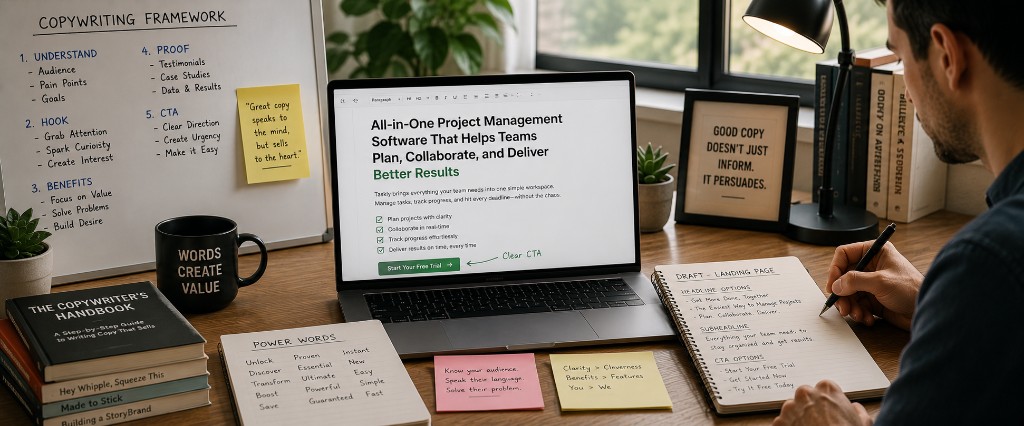
Website copywriting is not filling empty boxes after a page has been designed.
The message should help determine which sections the page needs and where they belong.
A focused landing page may follow this path:
Customer problem → solution → benefits → proof → process → objections → action
Each section has a job.
| Section | Question it answers |
|---|---|
| Headline | Is this relevant to me? |
| Value proposition | What will improve? |
| Benefits | Why should I care? |
| Proof | Why should I trust this? |
| Process | What happens next? |
| FAQ | What could stop me? |
| CTA | What should I do now? |
This is why content strategy should usually begin before final landing page design.
Start With the Customer's Frustration
Many websites begin by talking about themselves:
We are a passionate team committed to excellence.
That statement could belong to a contractor, clinic, accounting firm, or e-commerce company.
It does not reflect the customer's immediate problem.
A homeowner in Maple Ridge may be worried about unclear renovation costs. A clinic patient in Port Coquitlam may be unsure which treatment to book. A business owner in New Westminster may be frustrated by a website that attracts visitors but produces few enquiries.
Start where the customer already is.
For example:
Your website is receiving traffic, but visitors still struggle to understand why they should contact you.
The reader recognizes the situation before the service is introduced.
Practical tip: Use the "you before we" test
Review the first screen of your page.
When the copy talks more about the company than the customer's goal, rewrite the opening around the problem being solved.
Clarify the Value Proposition
A value proposition should quickly explain:
- What you provide
- Who it helps
- What outcome it supports
- Why the approach is relevant
Compare these two headlines:
Strategic digital solutions for modern businesses.
With:
Turn a confusing service website into a clearer path from search to enquiry.
The first sounds polished but vague. The second gives the visitor a situation and an outcome.
Clarity does not make the business sound less sophisticated. It makes the expertise easier to understand.
Translate Features Into Outcomes
Businesses naturally describe what is included:
- Keyword research
- Five-page website
- CRM integration
- Responsive layouts
- Automated email flows
Customers also need to understand what those features change.
| Feature | Customer outcome |
|---|---|
| Responsive design | Customers can use the page comfortably on their phones |
| CRM integration | Enquiries reach the right person without manual copying |
| Keyword research | Pages align more closely with what customers search for |
| Automated flows | Leads receive timely follow-up |
| Product filters | Shoppers find suitable products faster |
A feature explains the mechanism.
An outcome explains why it matters.
Strong website copywriting connects both.
Build a Clear Message Hierarchy
Not every sentence deserves equal attention.
Someone checking a service page during a rainy SeaBus commute may scan the headline, subheading, section titles, proof, and button before reading the details.
The page should still make sense at that level.
Use:
- One main promise
- Short section headings
- Brief supporting paragraphs
- Bullets for scannable details
- Visible proof
- A consistent primary CTA
Practical tip: Read only the headings
Hide the body paragraphs and read the headline and section titles in order.
Do they tell a complete story?
When the headings feel disconnected, the page structure probably needs more work.
Answer Objections Before the CTA
Customers often hesitate because the page leaves something unresolved.
A contractor's customer may wonder:
- Do you serve my area?
- What size of project do you accept?
- How does the estimate work?
A clinic patient may ask:
- Do I need a referral?
- How soon can I book?
- Is the treatment right for my situation?
An e-commerce shopper in Toronto, Quebec, Yukon, or the United States may need clear information about shipping, currency, returns, and delivery expectations.
Good copy does not pressure people past those concerns.
It addresses them.
Proof, FAQs, process explanations, guarantees, policies, and customer examples can all reduce uncertainty before the visitor reaches the final action.
Make the CTA Feel Like the Natural Next Step
Buttons such as "Submit," "Learn More," and "Contact Us" provide little context.
The CTA should describe what the visitor is moving toward:
- Request My Estimate
- Book an Initial Consultation
- Review the Service Options
- Get a Website Assessment
- Explore the Product Collection
The surrounding copy should also explain what happens afterward.
For example:
Tell us about your project. We will review the details and respond within one business day.
That feels more predictable than presenting an unexplained form.
Connecting the page through CRM and form integration can ensure that the promised follow-up also works behind the scenes.
Align Copy With Search Intent
Landing-page content must persuade people, but they first need to find and recognize the page.
A visitor searching "commercial cleaning company Squamish" expects different information from someone searching "how often should an office be professionally cleaned?"
The first query belongs on a service-focused page. The second may be better suited to an educational blog.
Keyword placement alone is not enough. The page format, message, and CTA should match the reason behind the search.
This is where copy strategy connects with SEO optimization.
Clear definitions, direct answers, descriptive headings, and consistent business information can also help support AEO and GEO visibility.
Design and Copy Should Work Together
A strong sentence can still fail when it is buried beneath a large image or squeezed into an unsuitable layout.
Copy and design should support the same reading path.
The headline introduces the promise. The visual reinforces it. The next section develops the problem. Proof appears near moments of hesitation. The CTA arrives when the visitor has enough information to act.
Think of it like signage on the Sea-to-Sky Highway.
The message must appear at the right moment, remain easy to understand, and guide the traveller toward the correct exit.
Give Every Page One Job
Your homepage introduces the business.
A service page explains one offer.
A landing page supports one audience, campaign, or action.
An About page builds trust.
A contact page removes friction from starting a conversation.
When every page tries to tell the entire company story, the most important message becomes buried.
Define the audience, conversion goal, search intent, and main promise before writing.
Then build each section around what the visitor needs to understand next.
Your customers should not have to decode your value.
Help them recognize their problem, understand the solution, trust the path, and take the next step with confidence.
Explore website copywriting services and turn your landing-page content into a clearer journey from first impression to action.