A customer joins your email list while waiting for coffee in Port Moody.
They were interested enough to subscribe—but nothing happens.
Two weeks later, they receive a generic promotion. By then, they have forgotten why they signed up, what your business offers, and what they were considering buying.
The subscriber was not cold.
The follow-up was simply too late and too disconnected.
Effective email marketing delivers the right message when the customer is most likely to need it.
A List Is Not Yet an Email Strategy
Many businesses collect email addresses through checkout, quote forms, events, or website pop-ups.
But the contacts remain inside the platform until someone remembers to send a newsletter.
That creates several missed opportunities:
- New subscribers receive no introduction
- Interested leads are not nurtured
- Abandoned carts remain unfinished
- First-time buyers receive no follow-up
- Past customers slowly forget the business
A local clinic may need appointment reminders and educational follow-ups. A contractor in Langley may need to nurture quote requests over a longer decision cycle.
An e-commerce company based in Vancouver may serve customers in Toronto, Quebec, Yukon, the United States, and beyond. Its emails must support customers through product discovery, purchase, delivery, and repeat ordering across a much broader market.
Map the Customer Journey First
Before building emails, identify the moments where customers commonly pause or need guidance.
A basic e-commerce journey might look like:
Subscribe → Browse → Add to cart → Purchase → Receive order → Buy again
A service-business journey may look like:
Download guide → Read emails → View service → Request consultation → Become client
Each stage requires a different message.
Someone who joined yesterday should not receive the same email as a loyal customer who has purchased five times.
Practical tip: Start with four questions
For each audience group, ask:
- What have they already done?
- What might they be uncertain about?
- What information would help them progress?
- What action should they take next?
This prevents email content from becoming a collection of random promotions.
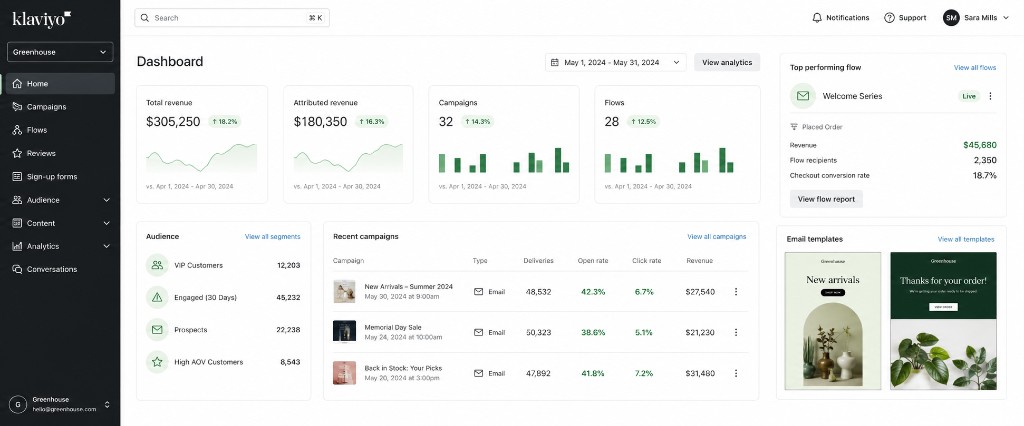
Use Automated Flows for Important Moments
Campaigns are scheduled messages sent for a particular promotion, announcement, or season.
Automated flows respond to customer behaviour.
Useful flows may include:
| Flow | Purpose |
|---|---|
| Welcome | Introduce the brand and guide the first action |
| Lead nurture | Educate prospects before they enquire |
| Abandoned cart | Bring shoppers back to unfinished purchases |
| Post-purchase | Set expectations and support the customer |
| Review request | Collect feedback after delivery or service |
| Win-back | Re-engage inactive customers |
| Browse abandonment | Follow up on viewed products or categories |
A customer ordering winter equipment for delivery to Yukon may need different timing and shipping information from a buyer in Toronto.
Automation should feel timely and useful—not robotic.
Segment by Behaviour, Not Just Demographics
Sending every email to the entire list may increase short-term reach, but relevance usually declines.
Useful segments can include:
- New subscribers
- Leads who have not enquired
- First-time customers
- Repeat customers
- High-value buyers
- Customers interested in specific categories
- Inactive subscribers
- Canadian and U.S. customers
For an e-commerce store, purchase history and browsing behaviour can support more relevant recommendations.
For a local service company, location, requested service, and lead stage may matter more.
Professional email marketing connects segmentation with the customer journey so each group receives a message appropriate to its relationship with the business.
Make Every Email Easy to Scan
Subscribers may open an email during a SkyTrain commute, between appointments, or while checking their phone at home.
They are unlikely to study a dense wall of text.
A focused email usually needs:
- One clear subject
- One main message
- A recognizable visual style
- Short, useful sections
- One primary call to action
Strong website copywriting principles also apply to email: understand the reader's frustration, explain the value clearly, and guide the next step.
Practical tip: Test the email without images
Temporarily hide the images and read only the headings, copy, and button.
Can the subscriber still understand the message and know what to do?
If not, the design may be carrying too much of the communication.
Protect Deliverability
A beautifully designed email has no value when it consistently reaches spam folders.
Deliverability can be influenced by:
- Sender authentication
- List quality
- Spam complaints
- High bounce rates
- Sudden sending-volume changes
- Misleading subject lines
- Low engagement
- Sending repeatedly to inactive contacts
Avoid purchasing email lists. Those recipients did not ask to hear from the business, and their lack of engagement can damage sender reputation.
Use clear consent, maintain clean lists, and give subscribers control over what they receive.
Test More Than Subject Lines
Subject-line testing is useful, but it is only one part of optimization.
Businesses can also compare:
- Preview text
- Offers
- Email layouts
- Calls to action
- Product recommendations
- Send times
- Long versus short copy
- Audience segments
Choose one variable at a time when possible. Otherwise, you may see a difference without knowing which change caused it.
Do not judge success only by open rate. Privacy features and inbox behaviour can make opens less reliable than downstream actions.
Clicks, form submissions, purchases, bookings, attributed revenue, unsubscribes, and repeat activity often tell a more useful story.
Connect Email With the Rest of the System
Email works best when it is connected to the website, online store, forms, analytics, and customer data.
A sign-up form should apply the correct source and segment. A product purchase should trigger the appropriate post-purchase flow. A consultation request should stop promotional lead-nurture emails that no longer make sense.
Thoughtful CRM and form integration can preserve lead data and trigger follow-up automatically.
For online stores, Shopify optimization can strengthen product data, customer events, and the buying journey that email campaigns send people back into.
Stay Useful After the First Purchase
Acquiring a customer usually requires more effort than sending one promotional email.
Once they buy, the relationship should not disappear.
Useful post-purchase communication might explain:
- What happens next
- How to use or care for the product
- When the order will arrive
- Where to get support
- What complementary product may help
- When it may be time to reorder
For service businesses, follow-up can include preparation instructions, educational resources, maintenance reminders, or a review request.
The goal is not to send more email.
It is to make the customer experience feel more complete.
Build a Journey, Not More Noise
Your subscribers have already raised their hands.
They joined the list, requested information, viewed a product, or completed a purchase. That attention deserves something more thoughtful than occasional mass promotions.
Map the journey. Segment by behaviour. Automate important moments, protect deliverability, and measure what happens after the click.
You do not need to fill every inbox.
You need to become useful in the moments that matter.
Explore email marketing services and build a clearer path from first interest to repeat action.