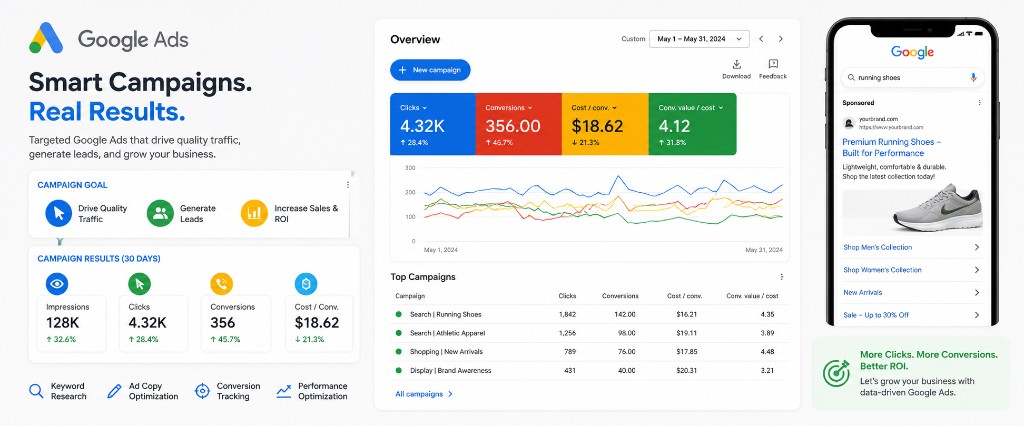
It is Monday morning, and your advertising dashboard already shows hundreds of clicks.
The campaign looks active. Impressions are rising. The budget is being spent.
But the phone is quiet.
A few enquiries arrive, yet most are outside your service area, looking for something you do not offer, or asking for the lowest possible price.
The problem is not simply that advertising costs too much.
Your campaign may be paying for attention that was never likely to become business.
Start With the Outcome, Not the Platform
Many campaigns begin with the wrong question:
Should we advertise on Google, Facebook, Instagram, or another platform?
A better question is:
What business result are we trying to create?
For a contractor in Maple Ridge, success may mean qualified project estimates. For a clinic in New Westminster, it could mean appointment bookings. For an e-commerce company shipping across Canada and the United States, it may mean profitable purchases rather than inexpensive clicks.
Define the primary conversion before building the campaign.
| Business goal | Useful conversion |
|---|---|
| Generate service enquiries | Completed quote request |
| Book appointments | Confirmed booking |
| Sell products | Completed purchase |
| Build a future audience | Qualified email subscription |
| Promote an event | Registration |
When the objective is unclear, campaign reports tend to celebrate activity instead of results.
Reach People With the Right Intent
A person searching "emergency plumber near me" is showing different intent from someone watching a home-renovation video.
Both audiences may be valuable, but they need different messaging and campaign strategies.
Search campaigns can capture existing demand. Social and display campaigns can introduce products, create interest, or reconnect with previous visitors.
Strong paid advertising matches the platform and message to the customer's buying stage.
Practical tip: Separate intent levels
Organize audiences into three groups:
- High intent: Ready to book, buy, or request a quote
- Consideration: Comparing providers or researching options
- Awareness: Interested in the broader problem but not yet ready
Do not send all three groups the same advertisement.
Stop Paying for Irrelevant Searches
Broad targeting may increase impressions while quietly reducing lead quality.
A renovation company serving Langley and Surrey may receive clicks from distant locations. A premium service may attract searches containing "free," "cheap," or "DIY." An e-commerce store may pay for visitors looking for a different product category.
Search-term reviews can reveal what people actually typed before clicking.
Negative keywords can then help prevent advertisements from appearing for irrelevant searches.
Examples may include:
- Jobs or careers
- Free resources
- DIY instructions
- Unavailable services
- Unsupported locations
- Unrelated product types
More clicks are not automatically better. The goal is to purchase the attention of people the business can genuinely serve.
Make the Offer Specific
An advertisement saying "Contact Us Today" gives customers little reason to stop.
A stronger offer helps them understand the value and next step.
Compare:
Professional landscaping services.
With:
Prepare your yard for summer. Request a landscape consultation in the Tri-Cities.
The second message identifies the situation, benefit, location, and action.
For e-commerce, the offer might focus on free shipping thresholds, product bundles, a seasonal collection, or a clear solution to a customer problem.
The advertisement does not need to explain the entire business. It needs to earn the next click from the right person.
Continue the Promise After the Click
Imagine seeing an advertisement for physiotherapy treatment near Port Moody.
You click—but arrive on a general homepage featuring several locations, dozens of services, recent articles, and company news.
The original promise disappears.
A focused landing page should continue the same message, audience, and offer used in the advertisement.
The page should quickly answer:
- Did I arrive in the right place?
- Is this service relevant to me?
- Why should I trust this business?
- What should I do next?
Advertising and landing-page design are one journey. Improving only the advertisement leaves the second half unfinished.
Track Real Conversions
Clicks, impressions, and video views help describe campaign activity, but they do not prove business impact.
Useful conversion tracking may include:
- Form submissions
- Phone calls
- Appointment bookings
- Checkout starts
- Purchases
- Revenue
- Qualified CRM stages
Tracking should also avoid counting weak actions as primary conversions. A page view is not equivalent to a sales enquiry. Clicking a phone number is not the same as completing a call.
For lead-generation businesses, connecting forms through CRM and form integration can help identify which campaigns produced qualified opportunities—not merely submissions.
For e-commerce stores, purchase values and product margins provide a clearer view of return on ad spend.
Test With a Purpose
Changing several elements at once may improve results, but it becomes difficult to understand why.
Create a clear hypothesis:
If we replace the general headline with a location-specific customer problem, the campaign will generate more qualified enquiries because visitors will recognize the relevance immediately.
You might test:
- Headlines
- Offers
- Images or video
- Calls to action
- Audience segments
- Landing-page openings
- Form length
- Product bundles
Test one major idea at a time when possible.
Not every campaign has enough traffic for statistically strong experiments. Smaller businesses can still use directional evidence, search-term data, customer feedback, and repeated performance patterns to make informed improvements.
Watch Lead Quality, Not Just Cost
A low cost per lead can look impressive until the sales team explains that most enquiries are unsuitable.
Review metrics closer to revenue:
| Metric | What it helps reveal |
|---|---|
| Cost per qualified lead | Cost of attracting a realistic prospect |
| Lead-to-sale rate | How often leads become customers |
| Customer acquisition cost | Total cost of gaining a customer |
| Return on ad spend | Revenue produced by advertising |
| Conversion value | Financial value of tracked actions |
| Repeat purchase rate | Longer-term e-commerce value |
A campaign producing ten strong leads may be more valuable than one producing forty weak enquiries.
This is where conversion rate optimization and sales feedback become essential. Advertising cannot be judged separately from what happens after the click.
Paid Ads for E-commerce
An e-commerce company based in Greater Vancouver may sell to customers in Toronto, Quebec, Yukon, the United States, or other international markets.
Its campaign structure may need to consider:
- Shipping regions and delivery costs
- Currency and market-specific pricing
- Product margins
- New versus returning customers
- Seasonal demand
- Product-feed quality
- Remarketing audiences
- Regional creative and messaging
A product with strong sales in British Columbia may perform differently in Ontario or the U.S.
Separate campaigns or audience groups can make performance easier to understand and budgets easier to control.
Paid media should also connect with Shopify optimization, accurate product data, clear shipping information, and strong product pages.
Know What to Pause and What to Scale
Good advertising management is not constant activity.
Sometimes the best decision is to pause an audience, remove a weak keyword, reduce spending on an underperforming region, or stop promoting an offer that does not convert.
At other times, a campaign may deserve more budget because it repeatedly produces qualified leads or profitable purchases.
Useful reporting should answer:
- What worked?
- What underperformed?
- Why might it be happening?
- What changed?
- What should happen next?
A dashboard shows movement. Interpretation creates direction.
Build a System, Not a Slot Machine
Paid advertising should not feel like putting money into a machine and hoping something returns.
Start with the customer and business objective. Target the right intent, sharpen the offer, connect the ad to a focused landing page, track meaningful actions, and optimize according to lead quality or revenue.
You do not need every person to click.
You need the right customer to recognize the message, trust the path, and take the next step.
Explore paid advertising services and turn ad spend into a more focused, measurable growth system.